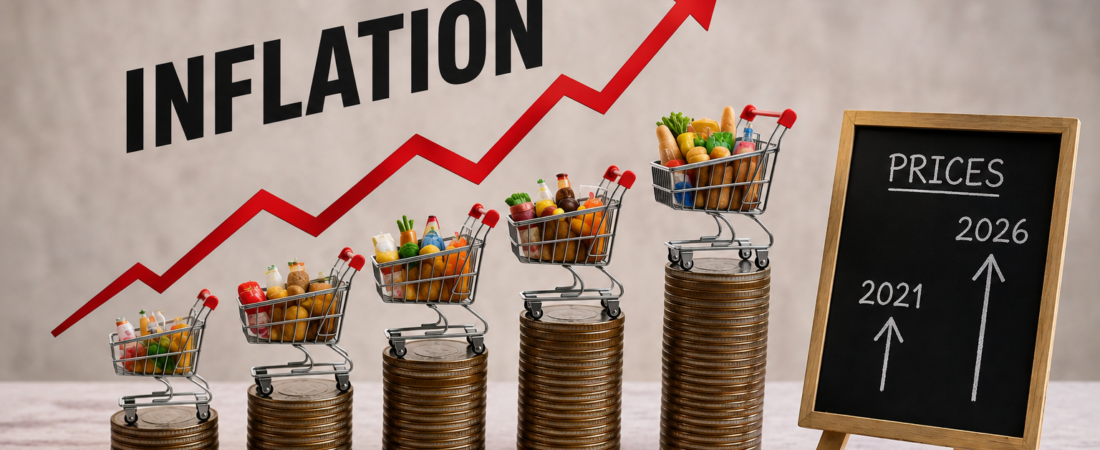
Remember when our parents’ generation could buy kilograms of flour with just Rs 5? Today, Rs 5 barely buys anything. This continuous rise in the general price level of goods and services is called Inflation. But it is more than a price increase; it affects everything from people’s purchasing power to economic growth and stability.
What is Inflation?
The increase in the general price level of goods and services in an economy is called Inflation. It means that when prices rise, consumers can’t buy the same amount of goods at the same price as they used to. So, consumers’ purchasing power decreases when prices rise, and it increases when prices fall.
Types of Inflation:
1. Demand-Pull Inflation: When there is demand for goods and services, the price of a product increases. Hence, inflation. For example, if consumers want to buy flour, but due to population growth, the producer can’t provide enough for everyone. The producer increases the price; demand for the product decreases.
2. Cost-Push Inflation: It happens when there is a rise in the production cost of goods and services, forcing businesses to increase the final price. This is known as Cost-Push Inflation.
3. Built-In Inflation: Arises when workers demand higher wages to keep up with living costs, leading to an increase in the price of goods and services. Hence, an increase in inflation.
4. Food Inflation: When there is an increase in the price of agricultural goods and food items.
5. Core Inflation: When there is a change in the cost of goods and services excluding volatile items like food and energy.
How does Inflation Affect us?
- Decreases consumers’ purchasing power
- Increases the overall cost of living
- Borrowings become expensive because the repo rate increases
- Rise in operational costs for businesses
- Decline in investment return
How does Inflation happen?
- Surge in consumer demand
- Increase in production cost
- Sudden spikes in food prices
- Higher transportation and logistics costs.
- Rise in global fuel prices
- Shortage of supply
How does the RBI control Inflation?
RBI uses Repo Rate (RR) as a tool to control inflation. When too much liquidity is available in the economy, demand increases, driving up production. This increases inflation as consumers have more disposable income. However, as manufacturing companies attempt to produce more goods, they may face supply constraints due to limited raw materials. This scarcity causes prices to rise, further increasing inflation.
RBI also uses Reverse Repo Rate (RRR) as a tool to control inflation when there is surplus liquidity available in the banking system. When inflation is on the higher side- meaning there is excess money circulating in the economy- the RBI increases the RRR. A higher RRR encourages banks to park their surplus funds with the RBI to earn higher returns, thereby reducing market liquidity.